Wednesday, 30 November 2016

Applying to work at BR


I got the job as a guard on BR after contacting a friend from university who worked for BR at Waterloo. He said that he knew they wanted guards at London Bridge, indeed were desperate to recruit guards.
I also saw this news story in the Daily Telegraph dated 18th August 1983:

Recruiting Ban Apology by BR
British Rail apologised yesterday to people who tried to get jobs yesterday as trainee guards only to be told at all stations that there was a total ban on recruiting.
“The shortage affects only some depots and at those we are recruiting,” said BR. “Southern Region is short of about 260 guards and this had led to many cancellations. We are certainly recruiting for essential jobs, but it as a case of enquiring to find out where the vacancies are.”

No, that’s not a typo; it does say Two Hundred and Sixty vacancies!

And why a ban in recruiting? Well, basically because the railways were in a sorry state. At this time the railways were not anything like what they are today in terms of passenger numbers etc. or government interest in investing in railways.
Mrs Thatcher and her government were still basking in the post-Falklands triumphs and privatising everything they could and railways, especially BR, were not seen as having a future, the onus was on getting rid of staff not taking on new people. While the London area and other parts of the UK have had lines added since this time, back in the early eighties the government was still thinking about closing down lines. Mrs Thatcher had, for example, commissioned the Serpell Report that came out in 1982 suggesting that the BR network could be pruned even more drastically than Beeching, Serpell proposed getting rid of 80% of the lines leaving the country with little more than two or three Intercity lines and some limited commuter routes in the South East. Other idiots came up with ideas for closing all the railways and covering the track beds in tarmac to turn them into roads and express coach routes!


Thus, in 1983, the dedicated Gatwick Express had not started running and yet it has now got to the point where it no longer runs.
This is a photo I took of a Class 73 loco approaching Norwood Junction at the rear of a Gatwick Express test run.


BR still operated trains on the Wimbledon-Mitcham Junction-West Croydon line as the Croydon Tram Lines had not even been thought of, indeed they’d just closed one of the rail routes that would later reopen as part of the tram network. The East London Line of the London Underground was a very minor affair to and from New Cross and New Cross Gate, now it is connected to the Central Division’s lines and has frequent services that run down to Crystal Palace and West Croydon.

There were no Docklands in need of a public transport link; the ruined Docklands had only just been designated as a redevelopment area. The dock’s main role, to my mind, was for it to be used as a location for car chases, murders etc. in TV cop shows like The Sweeney. So, there was no DLR at all let alone a link under the Thames to Lewisham, and the Jubilee Line terminated at Charing Cross.

The “ThamesLink” through lines in the tunnels between Blackfriars and King’s Cross via Farringdon had not been reopened, and the Central Division still served a Terminus at Holborn Viaduct. (It was strange/sad how Holborn Viaduct had become such a minor run-down station by 1983; when my great grandfather James Latchford Edwards set off for one of his mini-Grand Tours with Thomas Cook in the 19th century he set of for the Continent and North Africa from Holborn Viaduct.)

And people would have thought you mad if you’d suggested it would be a sensible idea to invest billions of pounds in a new railway to Heathrow, or a Channel tunnel and HS1, let alone CrossRail and HS2.

The trains were all as old as buggery too. The 4-SUB suburban stock that was withdrawn shortly before I started work at BR had been designed in 1939 and built during the war. The SUBs were meant to be excellent trains nicknamed “Shebas”, as in the quote from the (King James) bible: “The Queen of Sheba came with a magnificent train.”
see 4SUB


The 4-EPB stock I spent a lot of time on was also designed in the 1940s and built in the 1950s and used until 1995.
see 4-EPB


The electric multiple units (EMUs) that were used on mainline services (4RET, 4CIG, 4CEP etc.) which were first introduced in the 1960s when the mainlines to the coast were electrified where actually made by sticking electric motors under carriages from the 1950s and adding drivers’ cabs at the front! That said the 4REP used on Southampton and Bournemouth services was a powerful beast rated at 3,200hp (2400Kw): only a few horsepower less than the massive Deltic diesel locomotives!

BR trains were built to last though: the HST125 is still seen as a great train today - albeit with manually operated doors! - but it has just celebrated its 40th birthday and was designed only six or so years after steam trains were withdrawn! And the 4CEPs were in use for 49 years!
see: 4-CEP


A job as a guard did, however, seem like a reasonable way to start, as it was not about the idea of being a guard per se, but the fact that within the BR system you could work your way up the career ladder from such a position into management - though I would encounter a flaw in this principle later.
(I think the biggest problem I had with being a guard is that I had, and still have, a great deal of difficulty spelling the word GUARD correctly!)

Another important step I took that helped get the job was to move to London. In August 1983 Teresa and I found a top-floor furnished flat in Greenwich though it was old, cold, draughty, and generally only just bearable. But it was in a nice spot between the Cutty Sark and Greenwich Park. Once I was in London, in addition to having written BR a letter I was actually able to pop up to London Bridge to ask to see someone about a job. They were very helpful and, having applied for the job of guard, was almost asked for an interview by return of post.

I had an interview at London Bridge with the train-crew manager, himself a former guard; we seemed to get on well. (Having worn a suit and tie to that interview, I did note that very few other people in the office were in suits!)

I got offered the job before the interview was even finished, or at least I got offered the chance to be taken on to be trained as a guard. I recall that he asked me what my father would make of me working as a guard, given he was a doctor and stuff and that I had been to boarding school and university. I said that in the first place I expected that my father would be relieved I had got a job, and in the second place that he’d be happy that I was happy.

The pay was not great, well not for a London-based job. (I made notes during the interview and still have the notes!
The basic national pay/wage on BR was £72.20 for a 39-hour week, though, thanks to the unions, there was an agreement that nobody should receive less than £84.85, and my rate would go up to £90.25 after I’d finished training to be a guard. There was then an extra £14.95 per week for being based in London, an extra £1.80 per shift for working anti-social hours and another 55p per shift for working irregular shifts. On Sundays you were paid time-and-three-quarters if you worked overtime on your ordinary shift was paid at time-and-a-half.
These are, of course, gross rates of pay, and So I earned about £120 per week before tax and deductions; I usually took home just about £65 per week, as I remember noting that I usually had £30-35 available per week after paying the rent which was £30.


It is slightly bizarre that I got a job working on the Central Division of the Southern Region without ever having travelled on any part of the Central Division, yet I had travelled extensively on almost all the lines of the SE and SW Divisions! Thus, my first foray into the Central Division was when I was given a ticket and a chit to go down to the Head Office in Croydon for a medical! (I’m not even sure I’d have been able to point to Croydon on a map!)
Here's a photo of the ticket they gave me to go to East Croydon for that medical and it’s dated 25th August 1983. I think this was the day of the interview as the ticket is only for a journey from between London and Croydon and not between Greenwich and Croydon.


Tuesday, 29 November 2016

The Railway Monster awakens.


It was at Southampton University in the early 80’s that my interest in trains increased thanks to the arrival of a girlfriend in my life. Teresa: the girlfriend I married and to whom I am still married.

Trains were though very expensive to use, even with rail cards. As a university student, I recall hitching from Lyme Regis to London and from Oxford to Southampton rather than go by train. Trains were also not always convenient, for instance to get to Axminster station from Lyme Regis you first had to get a lift by car or catch a bus and many a rail trip was abandoned due to the bus running late and the connection being missed. Arriving five minutes late was useless when there was only a train from Axminster every two hours. (Even now with the addition of some extra track there is still only an hourly service.)

Approaching Salisbury from the West. Change at Salisbury for a train to Southampton

Trains were, however, the most obvious means of getting to see my girlfriend Teresa and for her to get to see me at times when we were not both in Southampton. The trip to Teresa’s parents’ house involved travelling on suburban services in SE London to get to Mottingham on the Dartford via Sidcup line.


Teresa waiting for a London train at Mottingham in 1981

Then trains became more interesting still when Teresa went to Germany for the summer vacation and getting to see her there now involved ferries and boat trains through Belgium to Cologne. That journey was one that made you stare out the window and pay attention to where you were and what the trains were doing. The fact that I’d be seeing Teresa at the end of the trip may also have contributed to the journey being enjoyable!

As for when Teresa had to spend a year at Tours in France, well trains then really entered the picture. I guess I went over to see her ten times and became very familiar with the rolling stock, fast expresses, the routes, the best places to sit, the interesting things to look out for, to say nothing of the busy Parisian stations at the Gare du Nord and Gare d’Austerlitz, and the Metro lines between the two.

While Teresa was in France lots of our university friends were also in France or Germany and, when one of them held a party to celebrate his 21st birthday in January 1981 a couple of dozen people decided to travel to Germany by train in to attend. Teresa and I opted to get an Interrail and go to the party and then be able to do even more travelling. Thus, in addition to going to Diez for the party, and to Koblenz en route, we also had some mini trips, usually to see friends in Wurzburg, Hamburg near Basel, in the Schwarzwald and in Angers. In a few weeks we experienced a lot of efficient modern trains and spent a lot of time enjoying views from train windows and, when waiting for connections, observing what went on at stations.

Heading north through the Black Forest near Donaueschingen in 1981


When I was in Tours I would often walk over to the main Terminus station if Teresa was busy. There I’d get to see the unfamiliar, including something unusual too, as that was where I first saw a TGV train. This was only 1981, still a while before TGV services were introduced and the first high speed line to Lyon was not even finished, so the TGV set that I saw was one of the test trains. The test train regularly came to Tours as testing at quite fast speeds was possible on the conventional tracks of the line between Paris and Bordeaux.

While in Tours Teresa did a project about the city, part of which involved an old street map from the early nineteen hundreds. On this map were assorted railway lines that no longer existed so we used to go for walks to investigate. Somehow this got me interested in routes and lines and planning as it started making me draw sketch maps etc. of where lines were, had been and might be. I began to get for railways. Back in the UK I started writing letters to BR with suggestions about reopening lines or stations, but not in some sort of nostalgic “Reverse the Beeching Cuts” way, more suggestions for how to improve services.

My interest in matters related to rail was thus now so large at this time, when I was unemployed, that, when I saw that Sir Peter Parker the Chairman of British Rail was to retire, I wrote to him asking how I should go about becoming his replacement. I got a very basic reply saying they would get back to me, then I received a reply from the British Railways Board saying that my enquiry about job opportunities at BR had been forwarded to my regional office at Waterloo.

I also wrote to the head of the GLC, a certain Ken Livingstone, with a vaguely similar question. And he replied in person, saying that, if I wanted to run British Rail, they I should either try and get a job at BR and get promoted up the ladder or try and become an MP in the hope that I might one day be made Minister of Transport. (I did keep the letter, but don’t seem to be able to find it.)


The real problem was that there were most definitely no jobs on the railway in Lyme Regis.

Monday, 28 November 2016

Trains in my childhood and teenage years.


I was not really interested in trains when I was younger. I was though (just) old enough to see steam engines in use as a child as there were still steam trains from our local station at Lyme Regis till about 1964 when I was four, these were replaced by smelly little diesels which ran till the line closed on 29th November 1965. (I have one of the last tickets issued in fact it might be the very last one as it was issued for 30th November the day after the line closed; it was also signed by various members of staff!). I remember the friendly driver Tom more than the trains. My sisters, who were older than me, occasionally used to ride on the footplate of the locomotive on their way to school in Axminster, though they would have to slip into a carriage at the intermediate stop at Combpyne to make sure the station master at Axminster did not see them breaking the rules. I rarely did more than blow the whistle (All very E.E. Nesbit!)

And here's a photo my mother took of my sisters and me with Tom the engine driver at Lyme Regis station!

This photo is also included at this website:


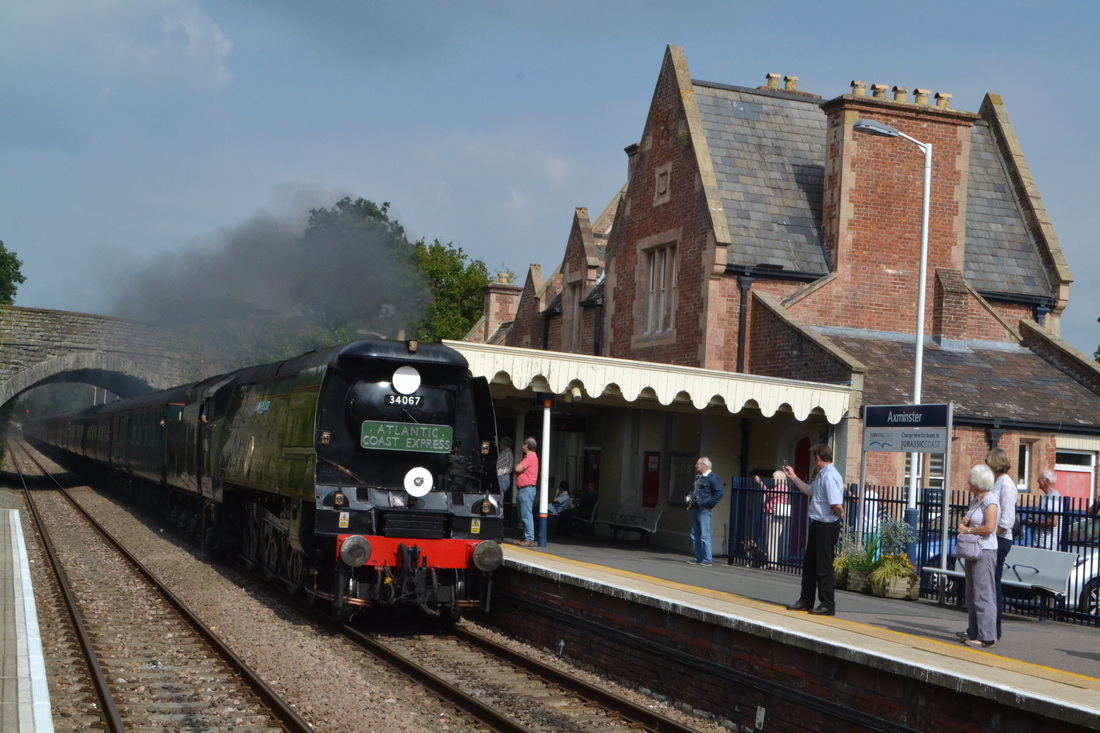
I have one vivid memory from about 1963/4 of a massive green steam locomotive thundering past the level crossing gates at Axminster; it really made the ground rattle and shake. It was possibly something like the Atlantic Coast Express (ACE), the Southern Region’s flagship express from Waterloo to Cornwall; it last ran in 1964 and it’s quite possible that my mother took me/us to watch the last run go past.

This picture of the new steam loco with an excursion version of the “ACE” at Axminster was taken in 2013. (Note the restoration of the second track through Axminster that was removed during the Beeching cuts.)


And here's the same train in a video that might give you an idea what it would have felt like for a small child standing low on the ground by the level crossing gates just a couple of feet from the track as it raced past.


After the Beeching cuts the number of trains in the area I lived in decreased dramatically, with almost all the branch lines closed down and the main line between Salisbury and Exeter reduced to a single track with passing places. So, my train memories then become more about their absence in great sections of the West Country so that car journeys invariably involved driving past out-of-use level-crossings and abandoned stations with grass etc. growing all over the place: Chard, Chard Junction, Seaton Junction, Seaton, Colyford, Newton Poppleford, Sidmouth, Budleigh Salterton, Bridgwater, Radstock etc. (and of course, Tiverton where Beeching saw no need to leave any sort of station for quite a large populkation centre othert than "Tivvy" Junction).

As a school boy I was primarily interested in cars: my vast collection of Matchbox cars was still around for my own children to play with; I had posters on the wall of the black & gold JPS Formula One car; I was a fan of car chases in films, and of muscle cars especially the Dodge Challenger after seeing Vanishing Point with Barry Newman.

Trains were only part of my life as a means of transport when other options were not available, though obviously, the occasional trip to see the sights of London with my mother was made by train. And one of those trips must have been when I was very young as there was still a restaurant car on the train on the journey home and my mother and I actually had dinner on the train. We also went on an excursion trip by train from Axminster to the Farnborough Air Show, though that was remembered because of the planes rather than trains (also remembered because of the very long walk between the station and show ground!)


I twice travelled home by train from boarding school in Gloucestershire, when my mother was unable to pick me up by car, and that was hardly the simplest of journeys. The only part I remember was that, as there was no station near the school in the Cotswolds, the first part of the journey as far as Bristol was by taxi: shared with another boy! I assume that I then went down to Exeter and caught another train from there to Axminster.


Trains were also a means by which relatives might come to visit us. My father’s sister Audrey who lived in Paignton, occasionally came up by train, though her old diaries indicate that she was often driven home by car, or driven as far as Exeter. My mother’s sister Cis who lived in Plymouth also came up a couple of times. When my eldest sister got married in 1978 my father’s cousin Margaret who he had never met, and who was seventy-five by then, made the journey down from Merseyside to Dorset, though it was not as complicated as it might have been, as I think she was able to catch a through train from Liverpool to Exeter, and may even have been met at Exeter by car.

When I went on an “expedition” to Ireland in 1976 I had to travel from Bridgwater to Windermere by train and all I recall of that journey was not having anything to eat or drink for hours, and having to stand all the way from Birmingham to Oxenholme. On the return journey, I travelled back via Liverpool Lime Street where I arrived very early on a Sunday morning and slept in the station concourse for an hour or so before there was a suitable train to catch.

I went on a couple of sixth-form school trips by train from Tiverton Junction (as was) to London, but I had no interest in what the train was or where it went. One only noticed the view out of the window at Slough if attempting to see the Mars Bar factory.

Before going to university I went to see a girlfriend in the Netherlands and I travelled by train and the Sheerness-Vlissingen ferry, but had no real idea where the trains were taking me in either country, all that mattered was to change at Sittingbourne and Rotterdam. From a train window, the Netherlands seemed particularly dull and Rotterdam station perhaps the dullest place of all as this photo I took shows.


And a nice negative railway memory from that Dutch trip was someone trying to sell us heroin in the station restaurant in Meppel.


One last observation about the older trains was the fact that I liked that they had corridors. Once in your compartment you were thus not disturbed by people walking up the middle of the train; on the other hand, as a very little boy, I used to love spending the journey not sitting still, but walking back and forth along the length of the train. 


Sunday, 27 November 2016

Some initial thoughts about my time on the railways.

I worked for British Rail Southern Region Central Division as a “Conductor guard” for a very short period from in 1983 and 1984, but that, and my interest in Railways has shaped my life quite a lot.
At the suggestion of my son Sam I have started this blog to describe a few things relating to my life and railways.

I liked, no I loved working for British Rail, but there may have been an element of masochism. The general public didn’t and don’t like the railways. I think the attitude towards BR in the 1980s is best summed up by me relating the following. I was in my BR uniform in Greenwich one afternoon at about 15:00 on my way home from work when some stranger stops me and starts having a go at me for not being at work, and accuses me of being on strike. I had worked more than 8 hours. Had set off for work at about 04:00, walked from Greenwich to New Cross on icy pavements, New Cross being the nearest place with a train to London at that time of the day, then after work was having to lug my kit and thick overcoat home again in time to eat get to bed early to get up at the crack of dawn the following day as well.
It was a real pain having to go to work early in the morning, when the temperature was really cold, but then come home in the afternoon when it was warmer, considerably warmer, but being forced to wear or carry your warm layers as you’d need them the next morning. (It could be a cold job: there were a number of the old men working as and training as guards who said they wore their wives worn out tights under their trousers when it was frosty!)
I also had passengers on a train complain about me being late turning up and thus delaying them, when in actual fact I was a replacement guard, as the booked guard was stuck somewhere else in another train. And, while my job that day was to cover exactly such problems, by working the train in question I was then going to work beyond my allotted hours for the day, so they had been about to cancel the service altogether.

British Rail felt to me like more of a National company than a Nationalised one. The idea that the government or a ministry were running it was ridiculous, they merely restricted the budget and set a few vague parameters; it was the ordinary members of staff running things; doing their level best with limited resources. I worked on trains that were designed in the nineteen forties and built in the nineteen fifties. How many ministers were driving around in cars or that vintage! I recall Mrs Thatcher once saying that she didn’t like to go by train as it was unpleasant and made you so dirty, she was right, but that was hardly BRs fault: would she have wanted to turn up to a summit being driven in a war-vintage Humber!

However, if you travelled around using a staff ticket you got treated like a member of a big family. It made no difference if you were based in South London, but travelling in Devon or Worcestershire or Essex, you were always treated like one of “us” by staff: ticket collectors, platforms staff etc. when they saw you has a staff ticket. There was not exactly a “secret handshake”, but anywhere and everywhere you went while at work and in uniform the greeting exchanged was “All right mate!” Occasionally the greeting would even do the job if you were not in uniform. I felt more camaraderie at BR than I ever did at boarding school. And I have not got out of the habit; to this day I still say hello to drivers and guards or tram drivers anywhere I encounter them.